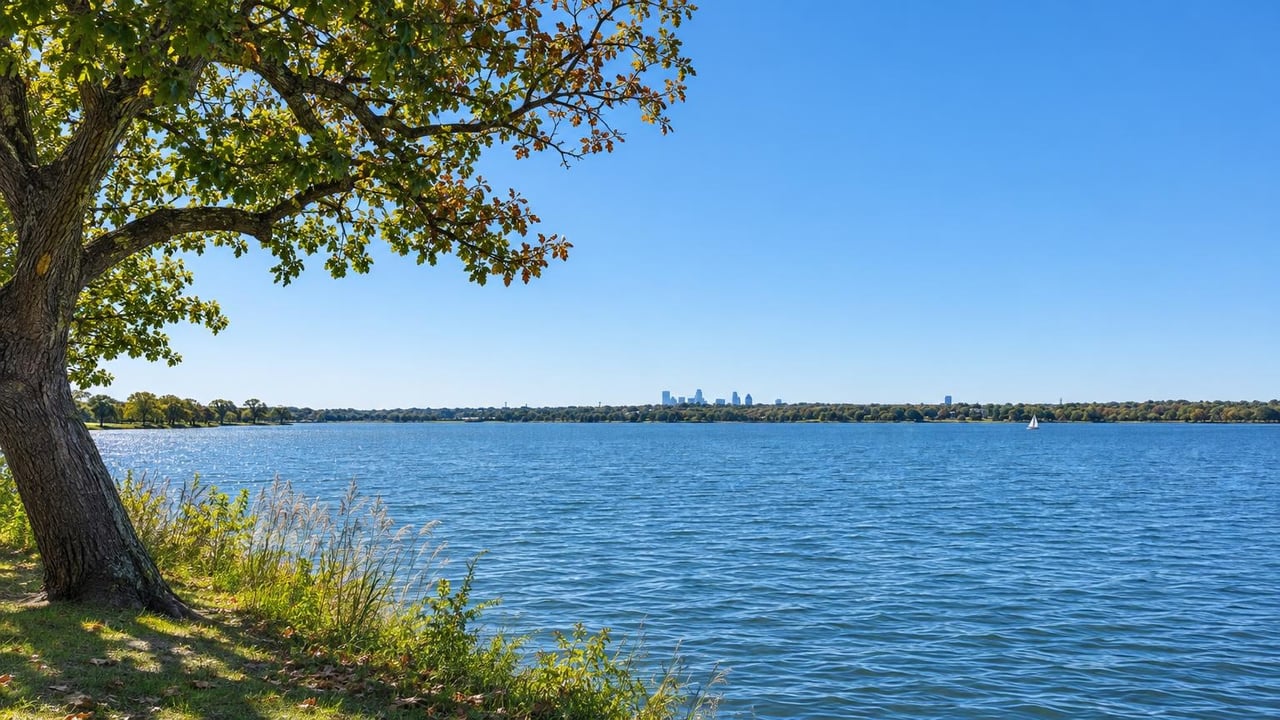
White Rock Lake's Next Dredge Is Planned as the First of Many
Sailors at Corinthian Sailing Club have a name for the mark a capsized boat leaves behind. When a sailboat goes over on White Rock Lake, the mast can sink several feet into the silt on the bottom and come up streaked with mud. Forest Atkins, the club's commodore, told the Lakewood/East Dallas Advocate in 2018 that sailors call it the "White Rock racing stripe." He also said the club's docks sat over about four and a half feet of water, just enough for keels to get through. The engineers who later studied the lake for the City of Dallas set 8 feet as the minimum depth for sailboats and other watercraft to pass safely.
White Rock Lake has not been dredged since 1998. Design work on the next dredge began this year. When it comes, it will be smaller than past dredges by design. The $20 million voters approved in the 2024 bond pays for only a few years' worth of the silt that keeps flowing in. That is a deliberate choice. The city is trying to turn dredging into a habit, so the lake never again sits for decades between cleanings.
The 2020 Freese and Nichols feasibility study counts four dredges since the lake was built, about one every 20 to 25 years. The first, finished in 1937, took three and a half years. It removed 400,000 cubic yards of sediment and reclaimed 90 acres of land. A smaller dredge in 1955 and 1956 removed 15,000 cubic yards. In 1974, about 1.35 million cubic yards were moved around to rebuild marshy areas and to create Mockingbird Point. So the point where people picnic and fish today was made from mud dug out of the lake.
The 1998 dredge is the one longtime East Dallas residents remember. By the 1990s, silt had left the north end of the lake less than a foot deep in places. Some ecologists predicted the whole lake would fill in by 2034, and a study found that oxygen in the water could drop low enough on some summer days to put the fish at risk, according to Texas Parks & Wildlife magazine. White Rock-area groups led the campaign for a bond issue that paid for half the job, and the city paid the other half.
From January to September 1998, a hydraulic dredge pulled up a slurry that was 90 percent water and 10 percent sediment. It pushed the slurry through a 24-inch steel pipeline to old gravel pits in Hutchins, south of Dallas, and filled about 200 acres of those pits with four to five feet of sediment. Those pits had been dug in the 1970s for dirt to build the highways that carried Dallas's growth north. The magazine pointed out the irony. Silt washed off that northern development and into the lake, then went back into the pits that had supplied it. The dredging crew also kept some of what came up from the bottom, including two bowling balls, a ski pole and skateboard parts.
The 1998 dredge was also a compromise. Burt Weatherbee, who managed the project for Carter & Burgess, told the magazine the team could remove only about 3 million of the roughly 5 million cubic yards of sediment in the lake within the budget. They worked toward a depth of at least eight feet across as much of the lake as they could. The Advocate's 2019 history puts the cost at $18 million. The feasibility study says the project finished ahead of schedule and under budget. Part of the reason was that the Hutchins landowner agreed to accept dredge material 24 hours a day at low cost.
Nine tributaries feed White Rock Lake. Some of the sediment is natural stream erosion. More of it washes in as development upstream replaces the farms and woods that once lined White Rock Creek. The lake takes in about 170,000 cubic yards of sediment in an average year.
The silt does not spread out evenly. The heaviest buildup is northwest of the Arboretum near Sunset Bay, where Dixon Branch, which runs through Old Lake Highlands and parts of East Dallas, enters the lake from the east side. The north end, where White Rock Creek flows in, also has a lot of sediment. In December 2025 the Advocate reported that the buildup at the north end is especially easy to see along West Lawther Drive.
The feasibility study leaves Sunset Bay out of the push to boating depth. Park staff consider it a roosting area for waterfowl, and roosting birds need water about 1.5 to 2 feet deep. The northernmost stretch near the White Rock Dog Park doesn't need the full 8 feet either. Boats mostly use the north part of the lake, where the White Rock Boat Club and Corinthian Sailing Club are. At the study's first public meeting, stakeholders asked the engineers to add the areas near Boomerang Boat House, White Rock Boat House and a kayak launch on the southwest side. Each part of the lake gets the depth its users need.
At a December 2, 2025 community meeting at the Bath House Cultural Center, Freese and Nichols presented what a full cleanout would take. Getting the whole lake back to its target depth would mean removing about 1.7 million cubic yards of sediment, at a cost of $54 million to $80 million in 2025 dollars. On a $20 million budget, the first round can remove only 300,000 to 600,000 cubic yards, all in targeted areas.
At 170,000 cubic yards a year, that first round removes roughly two to three and a half years of incoming silt. The engineers know that. "The goal here is to establish a dredge program, not just to do a single dredge project," Freese and Nichols engineer Patrick Miles said at the meeting, according to the Lakewood/East Dallas Advocate. He described the $20 million as groundwork for what could follow over the next five to seven years. The aim is to finish removing the 1.7 million cubic yards and also keep up with the new silt arriving every year.
District 9 Council member Paula Blackmon made the same point at that meeting. "We're trying to create a program and a process that we don't wake up one morning and go, 'Oh my God, we now got to find $80 million to dredge,'" she said. She added that keeping the infrastructure from 1998 would have made things a lot easier.
The silt also needs somewhere to go, and Hutchins took it in 1998. This time, McCommas Bluff Landfill in southern Dallas is one possible place to process the material. The engineers listed landfill cover, topsoil, compost and fill dirt as possible uses. "Hopefully the answer is not just, 'Well, throw it in the pit,'" Miles said.
This year the project moved from studies to design. On January 28, 2026, the Dallas City Council raised the Freese and Nichols engineering contract by up to $347,500, to $1,372,450. The increase covers detailed design, construction documents, bidding and construction administration. According to the Lake Highlands Advocate, the U.S. Army Corps of Engineers and Dallas Park and Recreation are paying for it. The Corps is also contributing $2 million to preliminary design through a partnership agreement, with a city match of no more than $666,666.67. Under the same supplemental agreement, the engineers will identify the environmental conditions for a recurring dredge every five to seven years.
The city's 2024 Bond Dashboard was last updated in August 2026. It lists the project as under design and shows design actually starting January 28, 2026. It estimates design will be finished by June 30, 2028, with construction from January 2, 2029 to December 31, 2030. The schedule Blackmon gave in August, as the Advocate reported in December 2025, had construction starting in August 2028 and ending in December 2029. Going by the city's current estimates, our read is that boaters and walkers shouldn't expect to see dredging on the water before 2029.
The dredge also fits into a larger plan. At the March 25, 2026 council meeting, adoption of the White Rock Lake Master Plan was item 12 on the consent agenda. In the council meeting recording, Blackmon said the lake had been run since 1911 under "a patchwork of more than a dozen overlapping plans and guidelines." She described the new plan as "not a list of immediate to do items," but a guide for identifying future projects and securing funding for them.
The design phase is when residents' views count most. Choices still to be made include which coves get dredged first, how deep each one goes and where the silt ends up. Blackmon's office takes comments on the project at [email protected]. The boathouse areas on the southwest shore are on the dredging map because stakeholders asked for them at the feasibility study's first public meeting.
At The Blackman Group, we keep track of the lake projects that will affect daily life in Lakewood for years, from Sunset Bay to the boathouses on the west shore. If you'd like to talk about how plans like this dredge fit with your own timeline on the east side of the lake, request a complimentary neighborhood consultation and we'll go through it with you.



press
Chi Omega Christmas Market is Back!
What drives The Blackman Group forward is our shared objective to serve clients at the highest level of professionalism, enthusiasm, and energy. Whether helping clients with a sale, a purchase, a lease, a relocation, or an investment, TBG operates with the standard that every transaction be a "'win" for our clients.

The Blackman Group
5960 BERKSHIRE LN STE 700 DALLAS TX 75225